
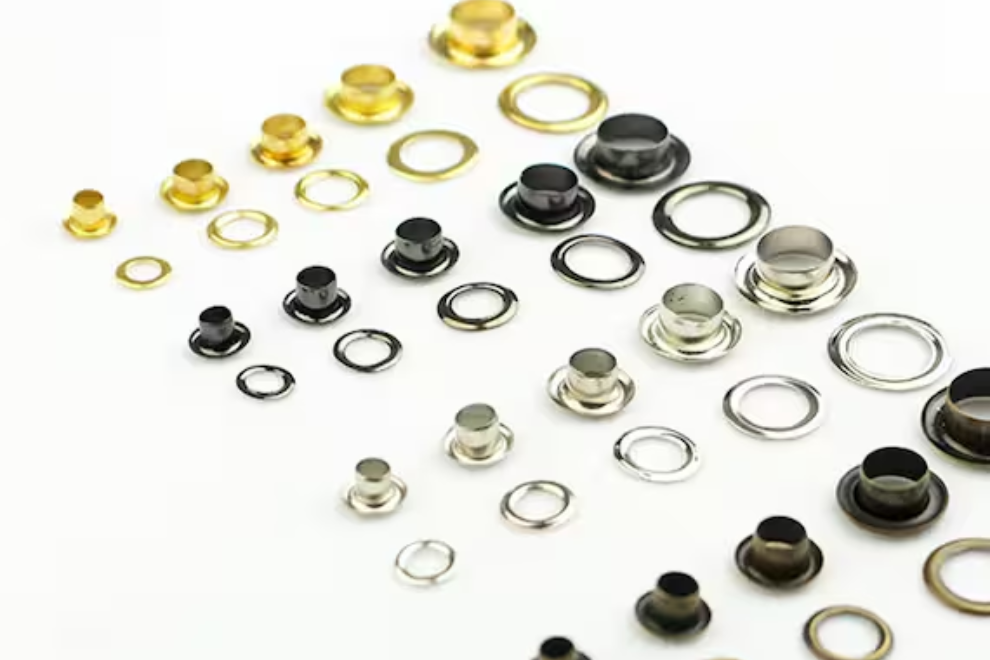
India is one of the largest manufacturing hubs for metal eyelets, supplying domestic industries and export markets alike. However, finding a genuinely quality-focused eyelet manufacturer — not just a low-price supplier — requires a disciplined approach. Eyelets are small components, but failures in strength, plating, or dimensional accuracy can lead to product rejection, warranty claims, or brand damage.
This guide explains how to evaluate and select a reliable eyelet manufacturer in India, step by step.
1. Start with Application Clarity (Before You Search)
Most sourcing failures begin with unclear requirements. Before contacting manufacturers, define:
- Application: Garments, shoes, tarpaulin, bags, flex banners, paper packaging, electronics, etc.
- Material: Brass, aluminum, mild steel, stainless steel
- Finish: Nickel, black nickel, antique, powder-coated, lacquered, rust-proof
- Load & stress requirements: Pull strength, corrosion resistance
- Compliance needs: Export standards, buyer QC norms
A serious manufacturer will ask these questions first. If they do not, treat that as an early warning sign.
2. Evaluate Manufacturing Capability, Not Just Price
In India, eyelet suppliers broadly fall into two categories:
- Traders/job-workers
- Integrated manufacturers
For consistent quality, prefer manufacturers with:
- In-house tooling and dies
- Controlled pressing and forming
- In-house or audited plating facilities
- Standardized inspection processes
Ask directly:
- Do you manufacture in-house or outsource critical steps?
- How do you control batch-to-batch variation?
Quality comes from process control, not from discounts.
3. Inspect Raw Material Standards
Eyelet quality is fundamentally determined by raw material.
A reliable manufacturer should:
- Specify grade and thickness tolerance
- Use consistent suppliers for metal coils/sheets
- Maintain traceability for large or export orders
Red flag indicators:
- Frequent changes in weight per 1,000 eyelets
- Unstable pricing without raw-material justification
- Visible cracking or deformation under pressure testing
4. Demand Samples — and Test Them Properly
Never finalize a supplier without physical samples.
Key tests to perform:
- Pull / stress test (especially for shoes and tarpaulins)
- Plating adhesion test
- Rust / corrosion exposure (basic salt or moisture test)
- Dimensional consistency across multiple pieces
Compare samples from at least 2–3 manufacturers. Quality differences become obvious when tested side by side.
5. Assess Quality Control Systems
Ask specifically about:
- Incoming material inspection
- In-process checks
- Final inspection before dispatch
- Rejection and rework policies
Manufacturers serious about quality will:
- Share inspection criteria
- Accept third-party inspection if required
- Maintain rejection records
Avoid suppliers who say:
“We have no complaints so far.”
That statement usually indicates no tracking, not perfect quality.
6. Check Industry Experience and Client Segments
Experience matters more than factory age.
A strong manufacturer often supplies to:
- Footwear exporters
- Large garment units
- Tarpaulin or industrial fabric companies
- Packaging or FMCG vendors
Ask:
- Which industries do you supply regularly?
- What is your highest monthly production volume for eyelets?
Consistency at scale is difficult — only mature manufacturers manage it well.
7. Understand Pricing Logic (Avoid the Cheapest Quote)
Extremely low pricing often hides:
- Thinner material
- Inferior plating
- Shortcuts in heat treatment or finishing
A quality supplier can explain price structure clearly, including:
- Material cost
- Plating or coating cost
- Tooling amortization
- Volume discounts
If pricing cannot be logically explained, quality will eventually suffer.
8. Verify Logistics, Lead Time, and Reliability
Operational reliability is part of quality.
Confirm:
- Standard lead time
- Emergency or repeat order handling
- Packaging standards (to avoid transit damage)
- Willingness to sign supply or quality agreements
Manufacturers who plan for long-term relationships invest more in consistency.
9. Location Matters — But Capability Matters More
India has strong eyelet clusters in:
- Maharashtra
- Gujarat
- Tamil Nadu
- Delhi-NCR
However, cluster presence alone does not guarantee quality. Focus on:
- Process maturity
- Technical knowledge
- Quality discipline
A smaller, process-driven unit often outperforms a large but unstructured factory.
10. Think Long Term: Supplier, Not Vendor
The best manufacturers aim to become:
- Technical partners
- Problem solvers
- Cost optimizers over time
Signs of a long-term supplier mindset:
- Suggesting design or material improvements
- Warning against unsuitable finishes
- Willingness to prototype custom eyelets
Get Simran eyelet’s stories in your inbox
Join Medium for free to get updates from this writer.
Final Thought
Eyelets may be small components, but they carry disproportionate risk if quality is ignored. In India’s competitive manufacturing environment, the right eyelet manufacturer is identified not by price alone, but by process control, material discipline, and reliability.
If you source carefully, a quality Indian manufacturer can deliver global-standard eyelets at scale, with long-term cost efficiency and peace of mind.