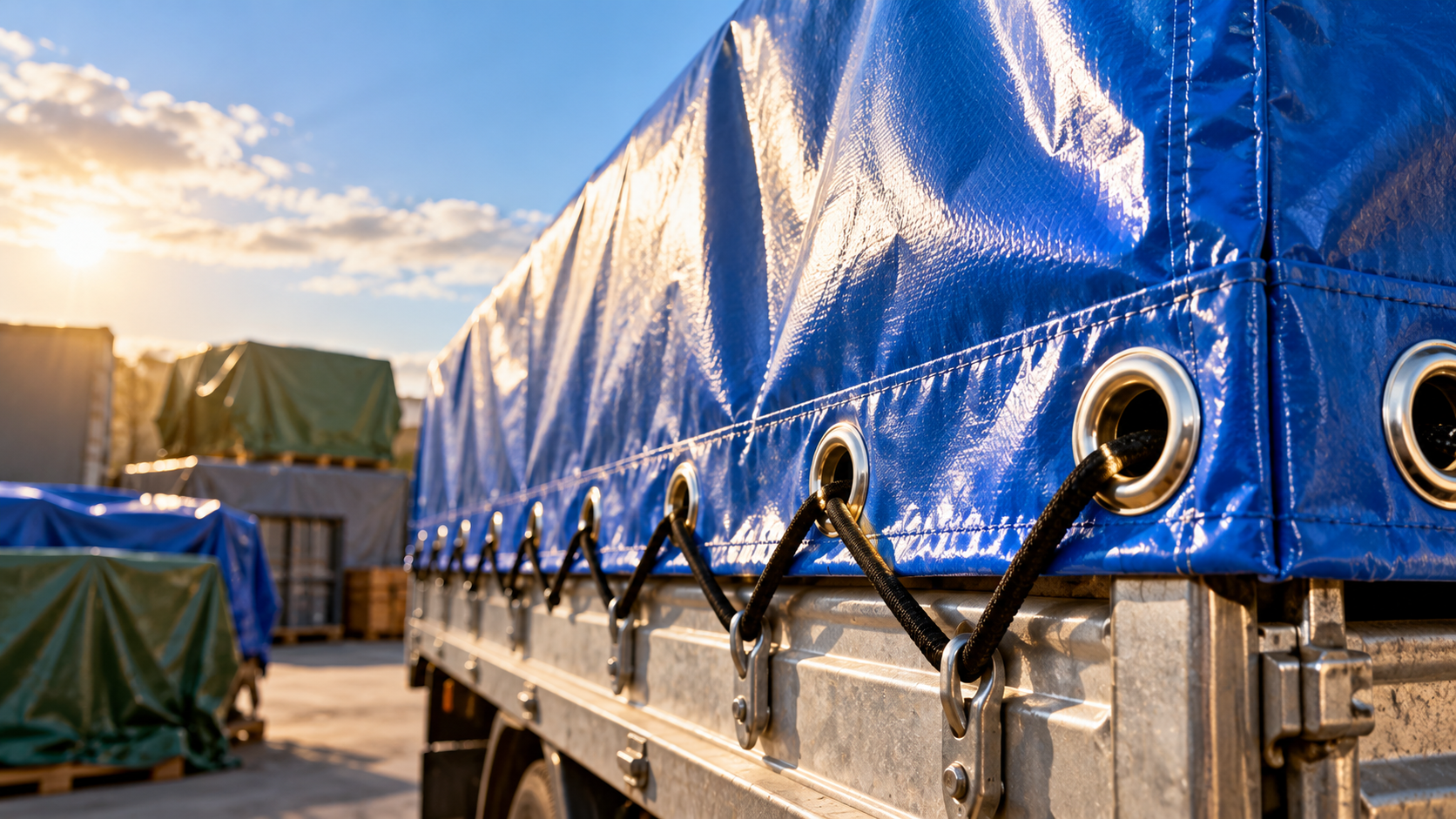
A tarpaulin rarely fails in the middle. It fails at the edge, at the exact spot where a rope pulls against a small ring of metal. That ring is the eyelet, and on a truck cover, a crop sheet or a large banner, it does far more work than its size suggests. Tarpaulin eyelets take the wind load, the tie-down tension and the daily tugging, and they have to do it for months outdoors. This post explains why they matter, what makes them different from ordinary eyelets, and how to choose ones that last.
Where a tarpaulin actually gives way
Fabric on its own has no strength at a cut hole. Pull a rope through a bare punched hole and the tension concentrates on a few millimetres of material. The sheet tears outward from the hole, usually at the worst moment, when the cover is loaded and moving.
It’s rarely one dramatic pull, either. Repeated tying, untying and flapping in the wind loosen a weak set over time, until the eyelet works free or the fabric around it wears thin.
A Tarpaulin eyelet changes that. The barrel lines the hole so the rope doesn’t chew through the edge, and the collar clamps flat against the fabric and spreads the pull over a wider area. The wide collar is the part people overlook. A strong barrel with a small collar can still let a cover tear around it.
What separates tarpaulin eyelets from regular ones
Garment and stationery eyelets are small because they carry almost nothing. Tarpaulin eyelets are built for load, so they’re bigger and more heavily reinforced.
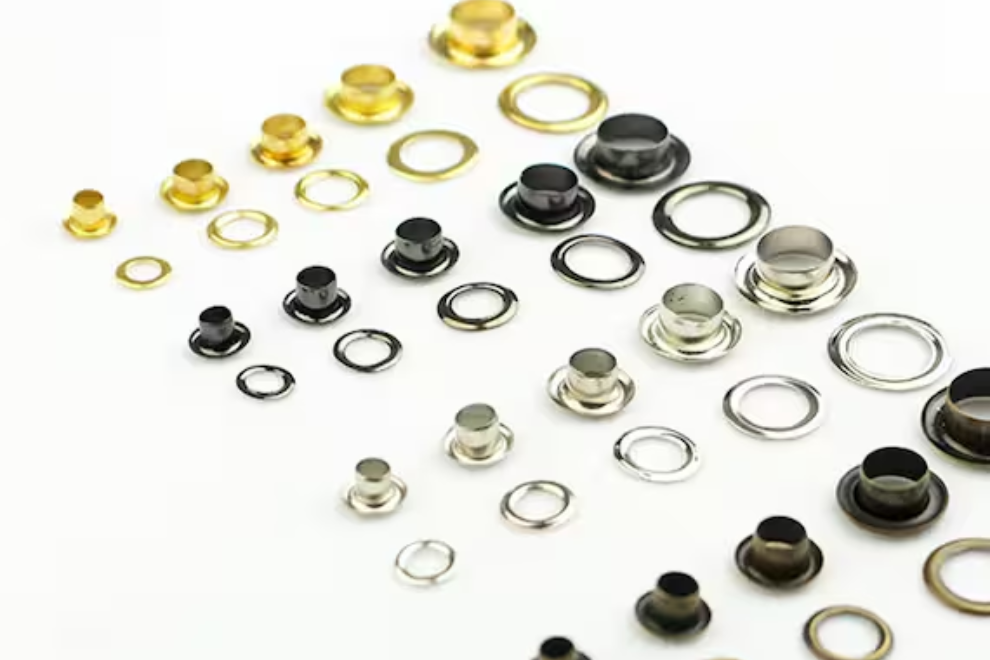
The dimensions on our range show it. The aluminium/steel tarpaulin eyelet has a 12.80 mm outer diameter, a 23.00 mm collar and a 6.70 mm height. The brass version runs 12.00 mm, 23.00 mm and 7.00 mm. Compare that with the small eyelets used on labels and tags, and you can see why one can’t stand in for the other.
Rust-proof eyelets in India: what the label really means
Almost every supplier listing says rust-proof.” Treat it as a starting question, not an answer.
Aluminium doesn’t rust the way iron does. Brass contains no iron, so it doesn’t rust either, and it holds a good finish outdoors. Stainless steel resists rust because of its chromium content. Plain steel is different: without plating or another finish, it will rust, and a cover that lives outside through a monsoon will show it.
So when you are sourcing rust-proof eyelets in India, ask which metal it is and what finish it carries. The answer matters most in three settings: coastal routes, farm covers left out for a whole season, and transport covers that sit wet for days between trips. The metal you need depends on how much water and salt the eyelet will see.
Finish is the second half of the question. Nickel, antique and lacquered looks all weather differently, so ask to see a sample that has spent some time outside before you commit to a bulk order.
Choosing by cover type
- Truck and trailer covers: These see vibration, wind and constant loading and unloading. You want a firm set and a finish that survives being wet.
- Agricultural covers and storage sheets: Long stretches outdoors with little attention. Corrosion behaviour counts more than looks here.
- Tents, canopies and event banners: Wind load and repeated staking. Brass often suits jobs where the eyelet is visible, and the finish is part of the product.
Weight is a real variable too. Aluminium keeps a large cover lighter and costs less per piece, while brass and steel give different balances of finish and strength. There’s no single right answer, only the right fit for the cover.
Getting eyelets for tarpaulin manufacturing right
If you make tarpaulins, the eyelet is only half the job. The other half is how it’s set.
Eyelets for tarpaulin manufacturing behave best when they go through a reinforced or folded edge, not a single thin layer of sheet. The hole size should match the barrel so the eyelet doesn’t rattle before it’s even rolled. And the press has to set every piece with the same pressure, because a run where some eyelets are loose and others are crushed will show up as returns.
Spacing matters as well. Set eyelets closer together, and the load is shared between more points, so no single one carries the whole strain. The right gap depends on the size of the cover, the weight of the fabric and what it’s holding down, so settle it before the first run, not after.
That’s why the die and machine matter as much as the eyelet. We supply power presses in 20-50 ton options and C-type configurations, along with manual, semi-automatic, and fully automatic eyelet punching machines and precision dies. Buying the eyelet and the tooling together means the size, die, and press are matched from the start.
Questions worth asking before you order
A supplier who knows tarpaulin work will be comfortable with these. Ask them:
- Which metal is this, and what is the finish? “Rust proof” alone isn’t an answer.
- What are the outer diameter, collar and height in millimetres? Sizes by name are how mismatches happen.
- Can I test samples on my own fabric? Set a few, hang a load from them, then leave one outside in the rain.
- Will sizing stay the same on repeat orders? A cover made in June should match one made in December.
- Can the same team supply the dies and press? Matched tooling avoids loose or crushed sets.
One red flag: a supplier who can’t tell you the material or dimensions and only quotes a price per packet. Cheap eyelets that tear cost far more than the packet saved.
Sourcing tarpaulin eyelets with less guesswork
Simran Eyelets is a trading house, so we work with established manufacturers rather than running our own production floor. That lets us keep tarpaulin eyelets in stock in aluminium, steel and brass, and supply the machines and dies to go with them. If you’re setting up a line or restocking an existing one, send us your cover type, the sizes you need and where the covers will be used. We’ll help you match the material and finish to the job.